
Home › Private Montessori School › Authentic Montessori
How to Tell if a Montessori School Is Authentic
"Montessori" isn't a trademark, so any preschool can put it on the sign. Here's what genuine Montessori looks like, the questions worth asking on a tour, and how our Springfield classroom measures up.
Same word, very different classrooms
In the United States, the name "Montessori" has never been protected. A school can use it whether its teachers completed a year of Montessori training or none at all, and whether children spend the morning choosing their own work or rotating through teacher-led stations.
That's why two "Montessori preschools" a few miles apart can feel nothing alike. The good news: authentic Montessori is easy to recognize once you know what to look for.
7 signs of an authentic Montessori school
1. Montessori-trained teachers
Lead teachers ("guides") hold a diploma from a recognized Montessori training program, such as AMI or AMS. A weekend workshop is not the same thing.
2. Mixed-age classrooms
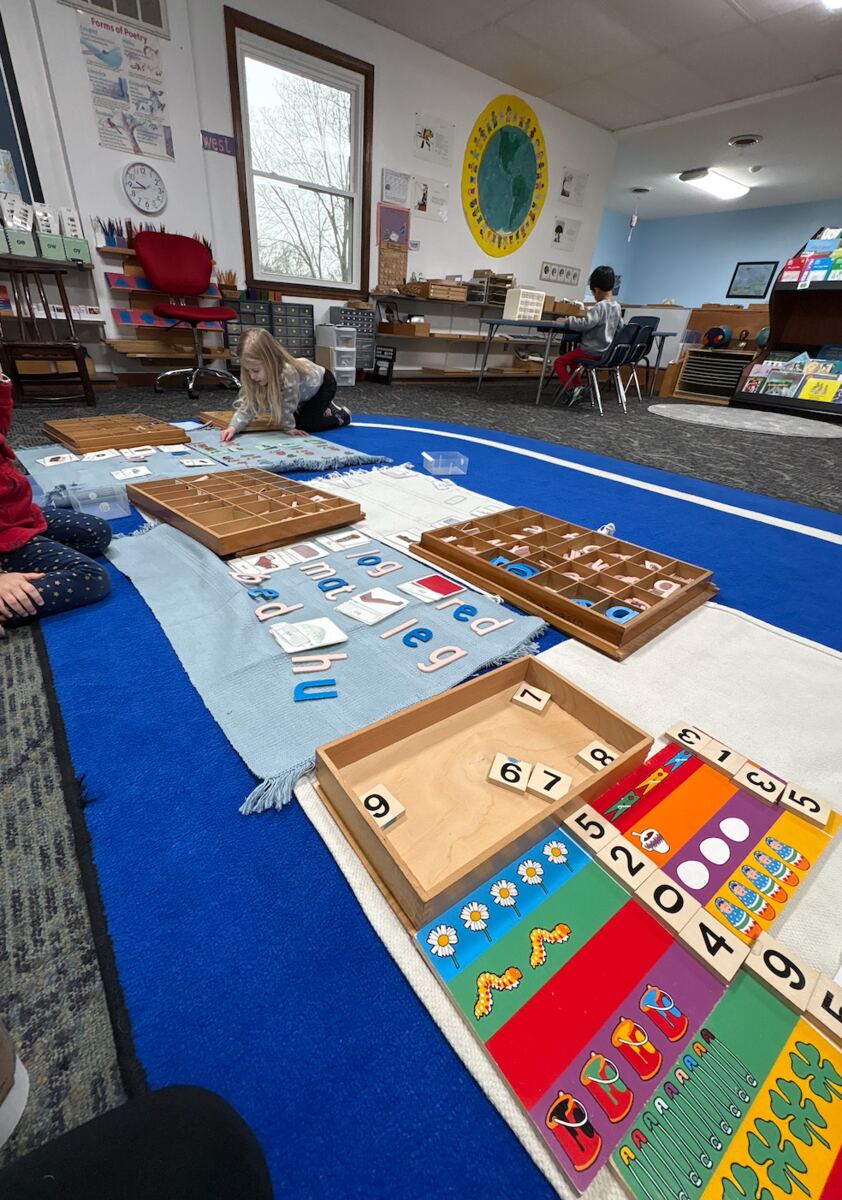
Children ages 3 to 6 share one room for three years. Younger children learn by watching; older children lead and teach. Single-age classes are a sign of a conventional preschool.
3. The real materials
Look for the Pink Tower, Golden Beads, Movable Alphabet, Sandpaper Letters, and Cylinder Blocks on low, open shelves — each material in one set, beautifully kept.
4. A long, uninterrupted work period
Montessori classrooms protect a long block of morning time, often up to three hours, so children can concentrate deeply instead of switching activities on a bell.
5. Freedom within limits
Children choose their own work and move freely, within clear ground rules. The teacher observes and gives short individual lessons rather than lecturing the whole group.
6. Practical life and grace & courtesy
Pouring, washing, sweeping, greeting a guest, waiting a turn. Everyday skills and manners are taught as real lessons, building independence and calm.
7. Hands-on, not screens and worksheets
Learning happens through the hands. Expect real objects, books, and art, not tablets, videos, or stacks of worksheets. Intrinsic motivation replaces sticker charts.
Questions to ask any Montessori school
- What Montessori training does the lead teacher hold, and from which organization?
- Which ages share a classroom?
- How long is the morning work period, and how often is it interrupted?
- Do children choose their own work?
- Are screens used in the classroom?
- Is the school a member of AMS or affiliated with AMI?
- Is it independent, or part of a franchise?
- May I observe the classroom while children are working?
How our classroom measures up
We're happy to be checked against the list above. Here's where we stand.
- Montessori organizationAMS member school
- Lead teacher trainingAMI-certified, 20+ years
- Mixed agesAges 3–6, one classroom
- Screens in the classroomNone, screen-free
- MaterialsPractical Life, Sensorial, Math, Language, Cultural
- Children choose their workYes, child-led
- Independent or franchiseFamily owned since 1987
- Second languageSpanish every day
Our lead teacher, Ms. Mahnaz, holds the Association Montessori Internationale (AMI) diploma; the school is a member of the American Montessori Society (AMS). Learn more about our Primary Program, our teachers, and how Montessori supports kindergarten readiness.
AMI vs. AMS: what's the difference?
AMI — Association Montessori Internationale
Founded by Maria Montessori herself in 1929. AMI trains teachers in her original approach, and its diploma is known for its depth and rigor.
AMS — American Montessori Society
Founded in the U.S. in 1960. AMS is a community of member schools and teacher-education programs that supports Montessori education across America.
Both are respected. At Little Sprouts you get both: an AMS member school led by an AMI-certified teacher.
Check us against the list. 👀
The best test of any Montessori school is watching a morning in the classroom. Visit us at 717 Rickard Rd, Springfield.